Lord Rama and Lakshmana goes in search of Sita after
Ravana abducted and took her away to Lanka. They had already formed
an alliance with the Vanaras and had an army ready to do battle.
A major problem confronted them all and that problem was how to get across the ocean to Lanka.
Only Hanuman at that point in time had done it but the
rest of the army did not have the capability to do so and
they all became afflicted with sorrow and unhappiness, Rama included.
Vyasa says to Janamejaya that Narada appeared there and had a conversation
with Rama.
Narada said to Rama that fasting for these nine nights, repeating
the sacred mantra of the divine Bhagavati and performing the sacred fire ritual
called Homa fulfills one's desires and brings immense happiness.
If you observe these vows as prescribed you will certainly recover Sita and will
be able to slay Ravana too. In ancient times Vishnu, Shiva and even Brahma and the other devas
also performed worship unto the divine Goddess. Therefore, Rama having fallen under great difficulties
you ought to do this auspicious ceremony without any hesitation.
 Narada told Rama that the sages Vishwamitra, Bhrigu, Vashistha and
Kashyapa all performed this worship before. When Brihaspati's
wife was stolen he too performed this great worship of the divine mother
and got back his wife. This vow was aslo practiced before by the mighty Indra for the
destruction of Vritrasura, by Mahadeva for illiminating Tripurasura
and by Narayana for the destruction of both Madhu and Kaitaba. Rama questioned
Narada as to who is this Devi, what is her name, what's her origin and what's her influence?
Narada told Rama that the sages Vishwamitra, Bhrigu, Vashistha and
Kashyapa all performed this worship before. When Brihaspati's
wife was stolen he too performed this great worship of the divine mother
and got back his wife. This vow was aslo practiced before by the mighty Indra for the
destruction of Vritrasura, by Mahadeva for illiminating Tripurasura
and by Narayana for the destruction of both Madhu and Kaitaba. Rama questioned
Narada as to who is this Devi, what is her name, what's her origin and what's her influence?
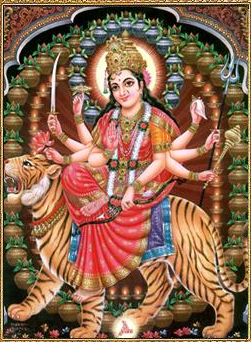
Narada replies to Rama by saying that the Goddess is eternal,
she is the source of all the Devas and of all living beings.
Without Her cosmic force nobody will be able to even lift a limb.
She is the preserving energy of Vishnu, She is the creative energy of Brahma
and She is the destroying force of Mahadeva. How can She have an origin when
all that exists in the universe exists only because of Her underlying force?
She is devoid of all qualities, the granter of Moksha, She is Prakriti
at it's fullest. She is the one from whom came Brahma,
Vishna and Mahesha and it is She who has empowered them
such that they can create the three Lokas. She existed before the Vedas and is
also the originator of the Vedas, She is therefore Supreme Knowledge itself!
 Then Rama asked of Narada to describe the rules and method of performing this
worship to the Devine Mother. Narada told Him all and
Rama took the vow on that very day and commenced the
fast and the worship in the prescribed manner. On the night of the eight day, pleased
with the worship of Rama and Lakshmana the Divine Mother appeared before the two brothers.
Remaining on the mountain top and mounted on a lion Chandika Devi
spoke to Rama and Lakshmana, reminding them of who they really are.
She revealed to Rama his purpose in this avatara and briefly described His many previous avataras.
She granted Him Her blessings so that He would meet with
success and happiness and then She disappeared.
Then Rama asked of Narada to describe the rules and method of performing this
worship to the Devine Mother. Narada told Him all and
Rama took the vow on that very day and commenced the
fast and the worship in the prescribed manner. On the night of the eight day, pleased
with the worship of Rama and Lakshmana the Divine Mother appeared before the two brothers.
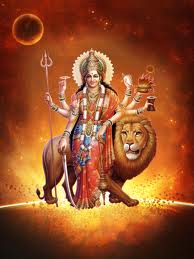
Remaining on the mountain top and mounted on a lion Chandika Devi
spoke to Rama and Lakshmana, reminding them of who they really are.
She revealed to Rama his purpose in this avatara and briefly described His many previous avataras.
She granted Him Her blessings so that He would meet with
success and happiness and then She disappeared.
Vyasa then said to Emperor Janameyjaya that filled with the renewed energy obtained from
the Divine Mother, Rama, Lakshmana, Hanumana and all the other
followers went to the shore of the ocean. Then they were
able to build a bridge across the ocean so that everone can reach Lanka.
A battle ensued and Ravana the enemy of the Gods, was vanquished by Rama. Sita was rescued and when
all was done Rama returned to Ayodhya and was crowned King. His fame and renoun
became known throughout all the Lokas. Such has been the glory and greatness
of worship done during Navratri.